Vaccines & Autism: What’s New?

Written by Dr. Amanda Kelly

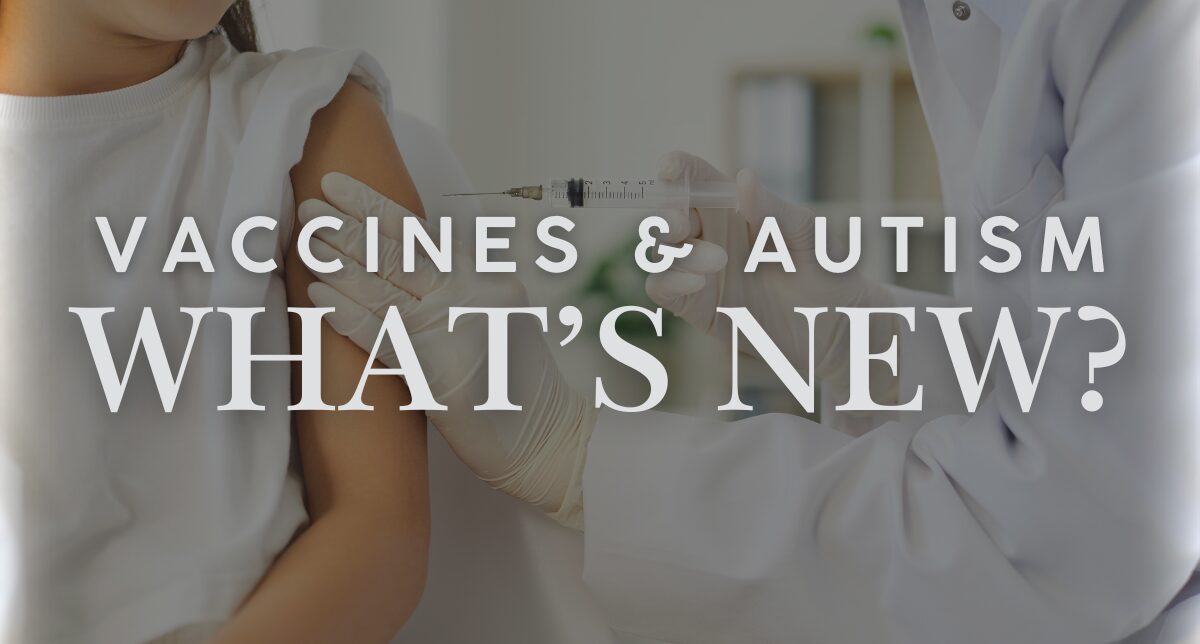
For the past few years, vaccines have taken prominent place in the news. There have been questions about safety, efficacy, and suggested links to autism, creating enormous confusion and fierce debate. Of course, the vaccine/autism debate is not new. A famously retracted paper published in 1998 implied a link between the MMR vaccine and autism, which decades of follow-up studies refuted repeatedly. In many cases this “study” was the basis for years of vaccine skepticism. More recently, disagreement between the Centers for Disease Control (CDC) and the American Academy of Pediatrics (AAP) on vaccine recommendations has created renewed confusion, which inevitably brings up the question of safety and links to autism.

In early 2026 the CDC, following a presidential directive to review practices of other developed nations, recategorized vaccines into three categories: 1. Immunizations recommended for all children (e.g., MMR, tetanus, varicella, HPV), 2. Immunizations Recommended for Certain High-Risk Groups or Population (e.g., RSV, Hepatitis A/B) and 3. Immunizations Based on Shared Clinical Decision-Making (e.g., COVID-19, flu). Part of the rationale for recategorization was that the U.S. is one of only a few developed countries to mandate vaccines. The AAP does not agree with the new CDC recommendations, and continues to recommend the full original schedule for all children.

So, what does this mean for families worried about the safety of vaccines? Regardless of disagreement on schedules, it remains that vaccines are the number one best and safest way to prevent serious diseases; this fact is not disputed. It is also important to understand that there is no proven link between vaccines and autism.

Autism itself is highly complex and often misunderstood. It is a developmental difference that exists on a broad spectrum, with diagnoses typically classified as levels 1, 2, or 3 based on support needs. Autism diagnoses may include co-occurring conditions and can occur with or without intellectual disability. It is highly individualized, with no single clear “cause”.

Research shows that a strong genetic component underlies most cases: inherited genetics and spontaneous gene mutations combined are thought to account for somewhere between 70–90% of autism cases. Twin studies, family history data, and the identification of hundreds of autism-associated genes support this. Environmental factors may also play a role, but the picture is nuanced, encompassing both prenatal factors (e.g., advanced maternal/paternal age, maternal infections, smoking, toxin exposure) and postnatal factors (e.g., recurring infections in early childhood) (Lebeña et al., 2024). It is also possible that environmental variables influence how certain genes express, rather than acting as direct causal agents.

In short, no vaccine ingredient, alone or in combination, has been shown to “cause autism.” Disagreement between major public facing organizations like the CDC and AAP in addition to public mistrust in a financially motivated healthcare system do nothing to help ease confusion and worry. It is important that families have trusted sources, can ask questions without fear, and know that they are getting the full picture from health professionals so that they can be fully informed on the best ways to keep their children safe and healthy.
Read on Medium.com

Leave Your Reply

Scroll to Top

Vaccines & Autism: What’s New?

Written by Dr. Amanda Kelly

For the past few years, vaccines have taken prominent place in the news. There have been questions about safety, efficacy, and suggested links to autism, creating enormous confusion and fierce debate. Of course, the vaccine/autism debate is not new. A famously retracted paper published in 1998 implied a link between the MMR vaccine and autism, which decades of follow-up studies refuted repeatedly. In many cases this “study” was the basis for years of vaccine skepticism. More recently, disagreement between the Centers for Disease Control (CDC) and the American Academy of Pediatrics (AAP) on vaccine recommendations has created renewed confusion, which inevitably brings up the question of safety and links to autism.

In early 2026 the CDC, following a presidential directive to review practices of other developed nations, recategorized vaccines into three categories: 1. Immunizations recommended for all children (e.g., MMR, tetanus, varicella, HPV), 2. Immunizations Recommended for Certain High-Risk Groups or Population (e.g., RSV, Hepatitis A/B) and 3. Immunizations Based on Shared Clinical Decision-Making (e.g., COVID-19, flu). Part of the rationale for recategorization was that the U.S. is one of only a few developed countries to mandate vaccines. The AAP does not agree with the new CDC recommendations, and continues to recommend the full original schedule for all children.

So, what does this mean for families worried about the safety of vaccines? Regardless of disagreement on schedules, it remains that vaccines are the number one best and safest way to prevent serious diseases; this fact is not disputed. It is also important to understand that there is no proven link between vaccines and autism.

Autism itself is highly complex and often misunderstood. It is a developmental difference that exists on a broad spectrum, with diagnoses typically classified as levels 1, 2, or 3 based on support needs. Autism diagnoses may include co-occurring conditions and can occur with or without intellectual disability. It is highly individualized, with no single clear “cause”.

Research shows that a strong genetic component underlies most cases: inherited genetics and spontaneous gene mutations combined are thought to account for somewhere between 70–90% of autism cases. Twin studies, family history data, and the identification of hundreds of autism-associated genes support this. Environmental factors may also play a role, but the picture is nuanced, encompassing both prenatal factors (e.g., advanced maternal/paternal age, maternal infections, smoking, toxin exposure) and postnatal factors (e.g., recurring infections in early childhood) (Lebeña et al., 2024). It is also possible that environmental variables influence how certain genes express, rather than acting as direct causal agents.

In short, no vaccine ingredient, alone or in combination, has been shown to “cause autism.” Disagreement between major public facing organizations like the CDC and AAP in addition to public mistrust in a financially motivated healthcare system do nothing to help ease confusion and worry. It is important that families have trusted sources, can ask questions without fear, and know that they are getting the full picture from health professionals so that they can be fully informed on the best ways to keep their children safe and healthy.

Read on Medium.com